








Catálogo Tokioschool

Just another WordPress site

Cloud Computing

  • Presentation
  • Methodology
  • Your classes
  • Online platform
  • Contents overview​
  • Digital teachers
  • Internships
  • Certifications
  • We are Tokio
  • Contact
  • Presentation
  • Methodology
  • Your classes
  • Online platform
  • Contents overview​
  • Digital teachers
  • Internships
  • Certifications
  • We are Tokio
  • Contact
  • Presentation
  • Methodology
  • Your classes
  • Online platform
  • Contents overview​
  • Digital teachers
  • Internships
  • Certifications
  • We are Tokio
  • Contact
  • Presentation
  • Methodology
  • Your classes
  • Online platform
  • Contents overview​
  • Digital teachers
  • Internships
  • Certifications
  • We are Tokio
  • Contact

COURSE

Cloud
Computing

Discover Tokio School

Presentation

The employees of the future will need to know the architecture of the cloud to be able to do their jobs. At present, almost all Spanish companies use the cloud in some way and the last years this process has accelerated enormously, which positions Cloud technologies as a key player. With all this, becoming a specialist in the Cloud environment is a great bet for the future.

With this course, you will be able to obtain the Cloud Computing certification from IBM

In addition, you will have access to the Cloud Computing course from IBM, one of the most important companies in the sector. A total of 80 hours, divided into theoretical classes, laboratories and case studies, will give you the technical experience to become a specialist in cloud services. Does this not seem like enough? Well, by taking the course you will have the chance to obtain the official certificate.

Objectives

Introduce the student to the public cloud
Explain how to design, deploy and manage environments and resources in the public cloud
Analyse strategies and architectures for high capacity, scalability and availability
Ec2 compression, functionalities, performance and their costs
Introduction to databases in AWS and Google Cloud
Management of applications and services

Career opportunities

Cloud systems architect.
Cloud systems administrator.
Hybrid systems administrator.
Software project manager.
Cloud solutions integration consultant/engineer/architect.

Methodology

Tailor-made method
Digital teachers
Personalised tutoring
Practical training
Online classes
Tailor-made method

Our courses do not have a start and end date. With Tokio’s 100% online training programme, you decide your pace, circumstances and capabilities and we follow you. Ours is «tailor-made» learning.

Digital teachers

They are your teachers, experts with real knowledge that will help you to improve your knowledge of this profession.

Personalised tutoring

Our educational advisors will accompany you throughout your training. They will help you achieve your goals through realistic objectives, organisation and motivation for tokiers!

Practical training

Self-assessment questionnaires, final exams, exercises, case studies… Learning by doing! You will learn by doing. In addition, you will have up to 300 hours of quality professional internships in companies in the sector.

Online classes

You will have live classes. And if you have not been able to attend, no problem! We’ll upload them to the virtual platform so you can watch them as many times as you want.

Final project
Soft Skills
Job Orientation
Employment Observatory
Final project

You’re almost there! To conclude your training, you’ll have to demonstrate everything you’ve learned through a project.

Soft Skills

You will receive extra training to improve your skills (communication, leadership, teamwork…) thanks to our short courses.

Job Orientation

We will give you all the keys to succeed in any selection process.

Employment Observatory

We put at your disposal, on the student platform, an Employment Observatory where you will find the best job opportunities according to your preferences and your sector.

Your classes

Live
You can connect live to the classes with your specialist teacher. The online classes will follow the syllabus and raise new questions and information that goes beyond the theoretical content of the books. At the end of each class, you can ask your questions so that the teacher can answer them live.
On a recorded basis
If you can’t attend a class live, don’t worry! All classes are recorded and uploaded to your platform so that you can access them whenever you want.
Doubt resolution
The digital teachers will dedicate the whole class to solving your doubts, exercises or practical cases. It is an excellent opportunity to interact with the specialist teacher, ask your questions and learn from the doubts of other classmates.
Masterclass

You will be able to attend online masterclasses given by renowned professionals in the sector who collaborate with Tokio School by sharing their experiences. These sessions will also be participative and you will be able to ask them your questions.

Online platform

Our methodology is designed so that you become

the protagonist of the learning process.

Content overview

Module 1: Getting started with the cloud

Unit 1: Introduction to the Cloud

  • What is the cloud, origins and evolution
  • The importance of cloud computing in digital transformation
  • OportTemaes and risks

Unit 2: Types of Clouds

  • Features and benefits of the public cloud
  • Main concepts: high capacity, scalability, availability, flexibility, pay-per-use…

Unit 3: Cloud Services

  • Working models in cloud
    • IaaS
    • PaaS
    • SaaS
  • Managed services and serverless
  • Shared responsibility

Unit 4. Datacentre: regions and availability zones

  • What is a datacenter?
  • Datacenter’s regions

Unit 5: Available Suppliers

  • Benchmarking: advantages and disadvantages of each supplier
  • How and which one to choose
Module 2: Google Cloud

Unit 1: Introduction to Google Cloud

  • Google Cloud
    • Origin and current status
  • Main differences with other suppliers
  • Available interfaces
  • Resources management
  • Billing and costs

Unit 2: Computer services

  • Virtual machines, clusters and disks
  • Containers and kubernetes
  • Serverless services

Unit 3: Storage and databases

  • Relational databases
  • Non-relational databases
  • Data analysis and data processing databases

Unit 4: Networks and connectivity

  • Networks and sub-networks
  • Firewalls
  • Routes
  • Load balancers
  • Networks interconnection

Unit 5: Security and access control

  • Identities management
  • Access control
  • Security services

Unit 6: Managed services 

  • Operations and monitoring
  • Events-based architectures
  • Cron jobs
  • Tasks queues

Unit 7: Operations and automation of deployments

  • Operations and monitoring
  • Automation with scripts
  • Continuous integration and deployment
  • Infrastructure as code

Unit 8: Reference architectures and solutions

  • Reference architectures
  • Applications internationalisation
  • High scalability
  • High availability
Module 3: Amazon Web Services (AWS)

Unit 1: Introduction to AWS 

  • AWS 
  • Origin and current status
  • Main differences with other suppliers
  • Available interfaces
  • Billing and costs

Unit 2: AWS and IAM Services 

  • Main AWS services
  • Services included in AWS Certified Solutions Architect 
  • Users, Roles y Groups.
  • Acces key and Secret Access Key 
  • Multi Factor Autentification 
  • IAM policies

Unit 3: Cloud Storage 

  • S3 storage types
  • Buckets creation and configuration
  • Encryption
  • Advanced storage

Unit 4: Elastic computing in the cloud

  • EC2 configuration
  • Advanced EC2
  • Command line

Unit 5: Networks and connectivity 

  • Virtual private Cloud
  • Routing
  • High availability

Unit 6: Databases 

  • Introduction to databases
  • Relational database service
  • Redshift
  • Advanced databases

Unit 7: Apps & Services  

  • AWS apps
  • Lambda
  • Serverless

Unit 8: Security 

  • Security patterns
  • Verification
  • Testing

Sukiru: habilidades para samuráis digitales

Tu formación incluye nuestro Curso Scrum Manager para que te conviertas en todo un experto en la aplicación de esta metodología de trabajo a nivel de equipos y puedas conseguir la certificación oficial Scrum Master

Conoce todos los detalles de este curso

Sukiru: soft skills for digital samurai

You will receive extra training to improve your skills (communication, leadership, teamwork…) thanks to our short courses.

#alwaysforward

Digital teachers

A software professional with 9+ years experience enabling digital transformations for multiple companies, with experience working with azure and aws for enterprise level transformation.
Nitin TomerSensei

Nitin-Tomer

Time to get on the tatami

Do you want to show what you’re worth? At Tokio School we have agreements with more than 3,000 companies in the technology and digital sector. You can do up to 300 hours of optional internships while expanding your network and your CV. Where would you like to do an internship? Suggest companies! You will be part of Tokio Net, our network of students and alumni.

Certifications

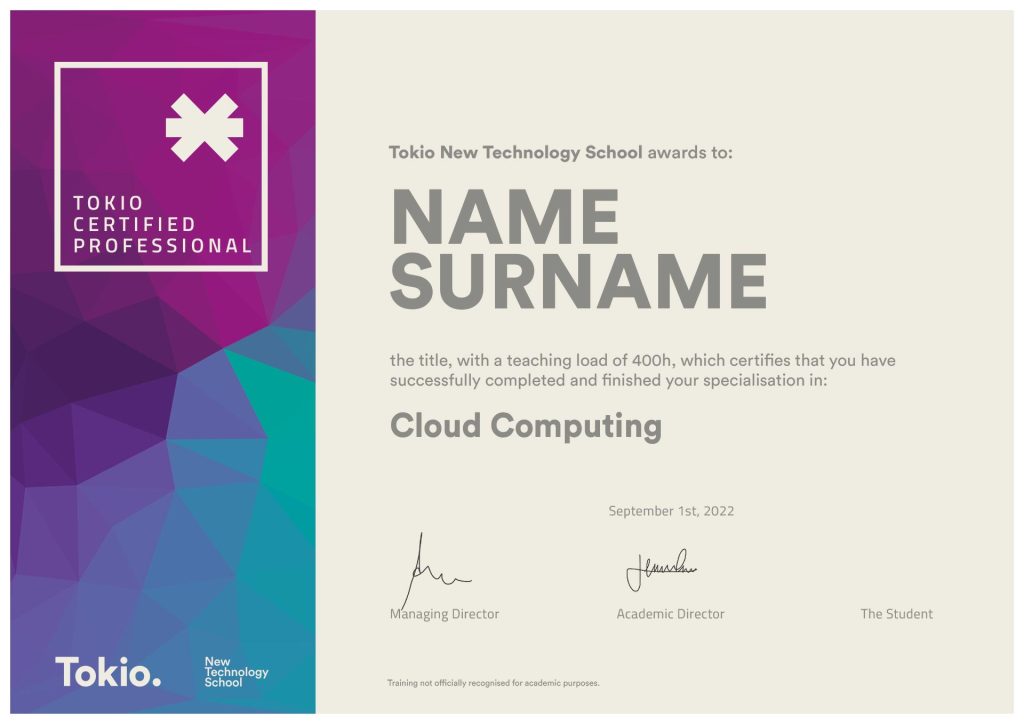
Once you have finished your training you will receive the following qualifications:

diploma-cloud-computing

Cloud Computing course

*Training not officially recognised for academic purposes.

We are Tokio

We’re not the kind of people who like to pin medals on themselves, but if others do…

excellence-2022_A-_Tokio_best_training_center_esports-2

TOP Educational Agreements

Contact

Do you have any questions? We are at your disposal for whatever you need.

+353 (1) 9026926

+31 (20) 3694593

+44 (20) 38079342

+32 (2) 7810204

+45 (7) 0890272

The content of this catalogue is subject to change at the discretion of the centre's management. The information not related to the centre contained in this catalogue is subject to the decision of the administration or competent authority.

Training is not approved for official academic purposes.

#alwaysforward

Módulo de Metodologías ágiles

Consigue la Certificación de Scrum Master

Al igual que evolucionan la tecnología y los lenguajes de programación, las metodologías de trabajo también cambian con el tiempo. Las organizaciones y empresas buscan constantemente formas de agilizar procesos, reducir costes y acelerar la producción para obtener mayores beneficios y es aquí donde la figura del Scrum Master es clave para gestionar de forma efectiva esos proyectos y alcanzar los resultados esperados. 

Nuestro curso en metodologías ágiles con Certificación Scrum te permitirá dominar esta metodología y convertirte en Scrum Master, una de las titulaciones y profesiones más demandadas actualmente. Además, te permitirá entender y aplicar otras metodologías Agile como Kanban, cada vez más en vigor en un mercado tan dinámico como el actual.

Salidas laborales

Scrum master
Scrum master
Consultor de proyectos ágiles
Consultor transformación Agile
Módulo 1. Introducción a la gestión ágil

Agilidad

  • Gestión predictiva 
  • Gestión ágil
  • Manifiesto ágil: valores y principios
  • Scrum

Desmontando la gestión de proyectos

  • Desarrollo, Trabajo y Conocimiento
  • Ingeniería secuencial, concurrente y agilidad

Diferenciando las prácticas de los principios y valores Scrum

  • Scrum técnico
  • Scrum avanzado
Módulo 2. El ciclo Scrum I

Roles

  • Propietario del producto
  • Equipo
  • Scrum Master

Artefactos

  • Pila del producto
  • Pila del sprint
  • Incremento

Eventos

  • Sprint
  • Reunión de planificación del sprint
  • Scrum diario
  • Revisión del sprint
  • Retrospectiva del sprint

Medición y estimación

Módulo 3. Principios y valores de Scrum II

Principios y valores

  • Las personas y sus roles
  • Artefactos
  • Eventos

Prácticas para flexibilizar Scrum

  • Gráfico burn down
  • Estimación de póquer
  • Kanban
  • Técnicas a prueba de errores
  • …
Módulo 4. La certificación Scrum Máster

Certificación vs Acreditación

  • Scrum Manager y Scrum Máster

Puntos de Autoridad. PDAs

  • Actualización de la Certificación

El examen

Certificación

Una vez realices este curso troncal, podrás presentarte al examen oficial de Scrum Manager. Si lo apruebas, recibirás el certificado de Scrum Master:

Machine Learning

Machine Learning was born from pattern recognition, but today it allows us to develop applications that improve their performance by «learning» from data collected in past situations. In this Python specialisation you will be able to apply Machine Learning to real projects, including preparation and related tasks, deployment in production and the lifecycle of a model.

MODULE 1: INTRODUCTION TO MACHINE LEARNING

Unit 1: Introduction to Big Data and Machine Learning

  • Introduction to Machine Learning
    • The theory of gravity
    • The scientific method
    • Mathematical models
    • Scientific method applications
    • Data science
    • Introduction to Big Data
    • Introduction to Machine Learning
    • The equation of the straight line
    • Model training
    • Working with Machine Learning models
    • Machine Learning applications
    • AlphaGo
  • Linear algebra
    • Relationship to the areas of big data, machine learning and artificial intelligence
    • Elements
    • Operations and properties

Unit 2: Work environment

Unit 3: Python and Scikit-learn numeric libraries

MODULE 2: SUPERVISED LEARNING

Unit 1: Linear regression 

  • Simple
    • Model equation
    • Graphical representation
    • Types of variables
  • Multivariable
    • Data modelling
    • Curve modelling
    • Analytical resolution
    • Cost function
    • Solving by iterative methods
    • Resolution algorithm

Unit 2: Gradient descent optimisation

  • Gradient descent
  • Convergence
  • Local and global minima
  • Learning ratio
    • Learning ratio choice
  • Training algorithm

Unit 3: Standardisation, regularisation and validation

  • Standardisation
    • Problem
    • What is standardisation?
    • Updated training algorithm
  • Regularisation
    • Deviation and variance
    • Regularisation
    • Regularised cost function
  • Cross-validation
    • Resolution methods
    • Dataset subdivision
    • K-fold
    • Updated training algorithm

Unit 4: Bayesian models and model evaluation

  • Example: carcinogenic cells’ classification
  • Sensitivity and specificity

Unit 5: Classification

  • Decision trees
    • Representation
    • Main concepts
    • Categorical and continuous target variables
    • Node splitting
    • Advantages and disadvantages of decision trees
    • Limitations on tree size
    • Tree pruning
    • Decision trees vs. linear models
    • Bootstrapping
    • Training algorithm
  • Logistic regression
    • Data modelling
    • Binary and multi-class classification
    • Hypothesis
    • Activation function: sigmoid
    • Cost function
    • Training algorithm: binary classification
    • Training Algorithm: multiclass classification
  • Classification by SVM
    • Logistic regression vs. SVM
    • Hypothesis
    • Kernels and landmarks
    • Hypothesis transformation
    • Types of kernels available
    • Cost functions
    • Regularisation parameter
    • Training algorithm: multiclass classification

Unit 6: Introduction to neural networks 

  • Natural neurons
  • Artificial neurons
  • Perceptron
  • Multi-layer or deep neural networks
    • Propagation of predictions
    • Cost function
    • Training
    • Multi-class classification
    • Training algorithm: binary classification
MODULE 3: UNSUPERVISED LEARNING

Unit 1: Optimisation by randomisation

  • Problem: local minima
  • Multiple initialisations
  • Implementation

Unit 2: Clustering

  • Differences between clustering and classification
  • K-means 
  • Other clustering algorithms
MODULE 4 – SEMI-SUPERVISED LEARNING

Unit 1: Anomalies detection

  • The problem
  • Anomalies in supervised vs. unsupervised and semi-supervised learning
  • Model representation
  • Choice of features
  • Normal or Gaussian multivariate distribution
  • Training algorithm

Unit 2: Recommendation systems

  • Linear regression recommendation systems
  • Recommendation systems approach
  • Cost function
  • Training algorithms
  • Prediction performance
  • Similarity between examples

Unit 3: Genetic algorithms

  • Natural evolution
  • Natural evolution of behaviour
  • Main concepts
  • Algorithms applied to optimisation
  • Examples
MODULE 5: AUTOMATIC LEARNING SYSTEMS DEVELOPMENT

Unit 1: ML systems approach

  • Initial approach
    • Data cleansing and transformation
    • Large-scale implementation

Unit 2: Feature engineering

  • Definition and characteristics
  • Creation of characteristics
  • Problems and solutions
  • Data quality

Unit 3: Principal Components Analysis (“PCA”)

  • Variables representation
  • Dimensionality reduction
  • Definition and applications
  • Visual representation

Unit 4: Assemblies

  • Definition and applications
  • Types of errors
  • Assembly techniques
  • Bagging
  • Max voting
  • Mean and weighted mean
  • Random forest
  • Boosting and adaptive boosting or AdaBoosting
  • Stacking

Unit 5: Models’ evaluation and improvement

  • Deviation and variance
  • Evaluation metrics: linear regression
  • Evaluation metrics: classification
  • Deviation and variance avoidance
  • Error analysis and evaluation of results 

Unit 6: Operations in ML

  • ML Engineering 
  • Operations in ML