Catálogo Tokioschool

Just another WordPress site

  • Presentation
  • Methodology
  • Your classes
  • Online platform
  • Contents overview​
  • Digital teachers
  • Internships
  • Certifications
  • We are Tokio
  • Contact
  • Presentation
  • Methodology
  • Your classes
  • Online platform
  • Contents overview​
  • Digital teachers
  • Internships
  • Certifications
  • We are Tokio
  • Contact
  • Presentation
  • Methodology
  • Your classes
  • Online platform
  • Contents overview​
  • Digital teachers
  • Internships
  • Certifications
  • We are Tokio
  • Contact
  • Presentation
  • Methodology
  • Your classes
  • Online platform
  • Contents overview​
  • Digital teachers
  • Internships
  • Certifications
  • We are Tokio
  • Contact

COURSE

Game Design

ZetaGaming-blanco-220x145

Official sponsors
of ZETA Gaming

Discover Tokio School

Presentation

The video game industry, the main engine of global entertainment, is evolving by leaps and bounds and companies are demanding more and more trained professionals. Experts focused on seeking efficiency in the development of the most innovative ideas that surprise and enhance the user experience to the maximum. In this sector, Game Design is the cornerstone.

Immerse yourself with Tokio School in the world of video game design from scratch. Learn how to design incredible scenarios, characters that look real. Get basic knowledge in modelling and texturing.

Objectives

Develop the GDD (Game Design Document)
Communicate the game design vision
Learn basic modelling and texturing skills
Become familiar with Unity, the most widely used video game development tool
Design game levels
Create the script, narrative and the workflow

Career opportunities

Level Designer
Level Designer
Game Designer
Game Designer
Gameplay Designer
Gameplay Designer
Videogame Scriptwriter
Video Game Producer
Video Game Producer
I was a very shy kid, but the games helped me a lot and I want to give this to other people. I feel very identified with Tokio because of the passion with which they do things.
Unai ZabalaExpert Package in videogame creation. Design & Unreal Engine Programming.

Unai Zabala
With a degree and a master's degree in gamification, I found it difficult to find a job and I came to Tokio to specialise. I found the university to be very individualistic, in Tokio I see everything as more connected.
Andreu IbáñezAdvanced course in videogames
Andreu Ibáñez
I've always dreamed of creating video games but I saw it as something unreal, until Tokio gave me the push I needed. I am a set of frustrated vocations and Tokio has reconciled them all.
Guillermo OrbeaVideo games programmer with Unity and Unreal Engine
Guillermo Orbea

Methodology

Tailor-made method
Digital teachers
Personalised tutoring
Practical training
Online classes
Tailor-made method

Our courses do not have a start and end date. With Tokio’s 100% online training programme, you decide your pace, circumstances and capabilities and we follow you. Ours is «tailor-made» learning.

Digital teachers

They are your teachers, experts with real knowledge that will help you to improve your knowledge of this profession.

Personalised tutoring

Our educational advisors will accompany you throughout your training. They will help you achieve your goals through realistic objectives, organisation and motivation for tokiers!

Practical training

Self-assessment questionnaires, final exams, exercises, case studies… Learning by doing! You will learn by doing. In addition, you will have up to 300 hours of quality professional internships in companies in the sector.

Online classes

You will have live classes. And if you have not been able to attend, no problem! We’ll upload them to the virtual platform so you can watch them as many times as you want.

Final project
Soft Skills
Job Orientation
Employment Observatory
Final project

You’re almost there! To conclude your training, you’ll have to demonstrate everything you’ve learned through a project.

Soft Skills

You will receive extra training to improve your skills (communication, leadership, teamwork…) thanks to our short courses.

Job Orientation

We will give you all the keys to succeed in any selection process.

Employment Observatory

We put at your disposal, on the student platform, an Employment Observatory where you will find the best job opportunities according to your preferences and your sector.

Your classes

Live
You can connect live to the classes with your specialist teacher. The online classes will follow the syllabus and raise new questions and information that goes beyond the theoretical content of the books. At the end of each class you can ask your questions so that the teacher can answer them live.
On a recorded basis
If you can’t attend a class live, don’t worry! All classes are recorded and uploaded to your platform so that you can access them whenever you want.
Doubt resolution
The digital teachers will dedicate the whole class to solve your doubts, exercises or practical cases. It is an excellent opportunity to interact with the specialist teacher, ask your questions and learn from the doubts of other classmates.
Masterclass

You will be able to attend online masterclasses given by renowned professionals in the sector who collaborate with Tokio School by sharing their experience. These sessions will also be participative and you will be able to ask them your questions.

Online platform

Our methodology is designed so that you become

the protagonist of the learning process.

Content overview

Module 1: Introduction to Game Design

Unit 1. What is Game Design?

Unit 2. The world of videogames

  • Companies and development teams
    • Triple A (AAA)
    • Double A (AA)
    • Indie studios
    • Independent
    • One-person studios
  • Job profiles in the videogames industry

Unit 3. What does a Game Designer do?

  • What a Game Designer do?
  • The Game Designer inside a studio
  • How to be a good Game Designer
    • Characteristics of a Game Designer
    • Disciplines that a Game Designer must be familiar with

Unit 4. The history of video games

  • Arcade machines
  • The emergence of the personal computer (PC)
  • Esports: the revolution

Unit 5. Game Design Document (GDD)

  • GDD concept
  • GDD templates
    • GDD template 1
    • GDD template 2
    • GDD template 3
Module 2: Fundamentals and principles of Game Design

Unit 1. Game concept

  • Rules
  • Quick analysis of a game. The three 5’s method
  • Game approach
  • MDA model

Unit 2. Mechanics

  • Mechanics and rules
  • Mechanics and systems
  • Core mechanics
  • Tutoring mechanics
    • Mastering of a mechanic: isolation principle
    • The “ninja” mechanics of games

Unit 3. Dynamics

  • Creating games’ dynamics
  • Game depth vs. complexity

Unit 4. Aesthetics

  • Videogame genres
    • Adventure
    • Action
    • Shooter
    • Puzzle
    • RHYTHM
    • Role Playing Game (RPG)
    • Sports 
    • Strategy
    • Construction and Management
    • Other genres
  • The wheel of genres in videogames

Unit 5. Types of players: Bartle’s taxonomy

Unit 6. Game Theory

  • What is game theory?
    • Representation structures
  • Game type
  • Nash equilibrium
Module 3: Storytelling

Unit 1. History of storytelling

  • Literature, cinema and video games
  • First storytelling experiences in video games

Unit 2. Key storytelling concepts

  • The conflict
  • The three-act structure
    • The first act: setup
    • The second act: confrontation
    • The third act: resolution
    • Plot points
    • Tension and pace
    • Three-act outline
  • The hreo’s journey: the monomyth
    • Archetypes
    • Structure

Unit 3. Characters

  • The hero or the heroine
  • The villain or the villainess
  • Character arches
  • Character sheet

Unit 4. The story and the world

  • Exposition
    • Show, don’t tell
    • Categorising information
    • Foreshadowing
  • Credibility
    • Consistency
    • Coincidences
    • Surprise
    • Spectacle

Unit 5. Storytelling in video games

  • Game history vs. Player history
  • Storytelling vs game design
  • Description of locations and levels

Unit 6. Temporality and storytelling

  • Game time vs story time
  • Order
  • Pace
  • Frequency

Unit 7. Storytelling experiences

  • Case study 1: To the moon
  • Case study 2: Undertale
  • Case study 3: Pony Island
Module 4: Game engines I

Unit 1: Introduction to Unreal Engine

  • Why use Unreal Engine if you are a Game Designer?
  • Installing Unreal Engine

Unit 2: First steps with Unreal Engine

  • Prototyping
  • Static Meshes
  • Landscapes

Unit 3: General scripting concepts

  • How does the blueprint system work?
  • Events
  • Variables
  • Actors

Unit 4: Introduction to Unity 3D

  • Why use Unity 3D if you are a Game Designer?
  • Installing Unity 3D

Unit 5: First steps with Unity 3D

  • Panels

Unit 6: GameObjects and components

  • Primitives
  • Components

Unit 7: Unity’s programming language

  • Scripts
  • Variables
  • Arrays
  • Functions
  • Control structures

Unit 8: Prefabs and scenes

  • Prefabs
  • Scenes
Module 5: Levels and combat design

Unit 1: Systems design

Unit 2: Introduction to level design

Unit 3: Storytelling and level design

  • Environmental Storytelling
  • Level Design
  • World Design
  • Recapitulating

Unit 4: Composition

  • The close-up
  • The element of interest or dominant
  • The background
  • Good compositions examples

Unit 5: Level’s creation process

  • Setting and theme selection
  • Taking references
  • Sketches and concept art
  • Graybox / Blockout / Block mesh
  • Beautification / Art Pass / Level’s dress up

Unit 6: Introduction to combat design

Unit 7: Defensive manoeuvres

  • Parry
  • Animation cancelling
  • Controls

Unit 8: Creating enemies: Artificial Intelligence (AI)

  • Cheat without the players noticing
  • Telegraph their actions
  • Have different personalities (or any)
  • Be predictable
  • Interact with the game systems
  • React to the player’s actions
  • Conclusion
Module 6: Game engines II

Unit 1: Materials and Lighting in Unreal Engine

  • Shaders
  • Lighting types

Unit 2: Advanced lighting in Unreal Engine 

  • Effects and post-processing
  • GI model for animations

Unit 3: Communication between actors in Unreal

  • Comunicación between actors
    • Using public variables
    • Level blueprint
    • Blueprint interface
    • Actor component
    • Blueprint library

Unit 4: Project modes and cameras in Unity

  • Perspective cameras and ortographic cameras

Unit 5: Introduction to lighting

  • Lighting techniques
  • Light types
  • Shadows

Unit 6. Lighting and post-processing with Unity 

Unit 7: Physics and tools in Unity

  • Rigidbody
  • Colliders
  • Tools

Unit 8: Canvas

Unit 9: Sprites 

  • Sprite renderer
  • Tileset
  • Spritesheet
  • 2D camera and Cinemachine
  • Scene organiation
  • 2D level developments without sprites

Unit 10: Grid use 

Unit 11: Geometries

Sukiru: habilidades para samuráis digitales

Tu formación incluye nuestro Curso Scrum Manager para que te conviertas en todo un experto en la aplicación de esta metodología de trabajo a nivel de equipos y puedas conseguir la certificación oficial Scrum Master

Conoce todos los detalles de este curso

Sukiru: soft skills for digital samurai

You will receive extra training to improve your skills (communication, leadership, teamwork…) thanks to our short courses.

#alwaysforward

Students' work

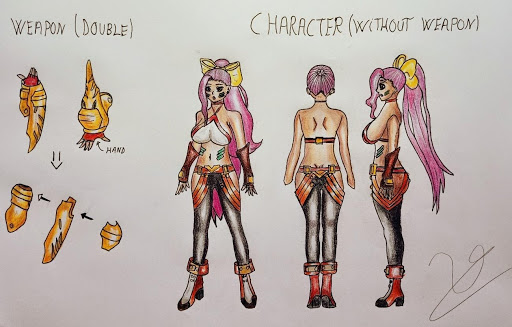
Final project Unai Zabala Professional career in Video Game Design

Although it is still in progress, the student’s project aims to be a video game. More specifically a ‘3D fighter’ where there will be unique and eye-catching characters with devastating final attacks. The combat will be very animated, resembling the combat system of the «hack and slash» genre, and with a hand-drawn character design!

Digital teachers

Game Designer and Product Manager with over 10 years of experience in design and production of video games. Creative contributions to various projects.
Ashkan AbediSensei

Ashkan-Abedi
Media and communications professional, she's been working in as a media writer, script and video creator, game designer, creative director and as a Brand Manager.
Yugishtha ShrivastavaSensei

Yugishtha-Shrivastava

Time to get on the tatami

Do you want to show what you’re worth? At Tokio School we have agreements with more than 3,000 companies in the technology and digital sector. You can do up to 300 hours of optional internships while expanding your network and your CV. Where would you like to do an internship? Suggest companies! You will be part of Tokio Net, our network of students and alumni.

Certifications

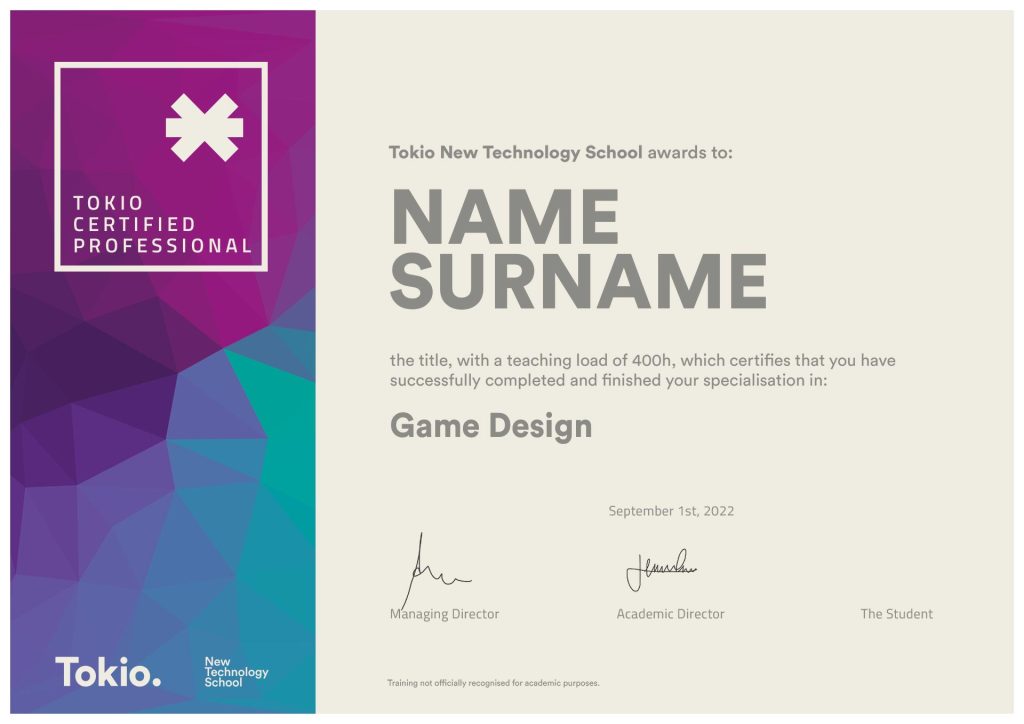
Once you have finished your training you will receive the following qualifications:

diploma-game-design
Game Design Course
*Training not officially recognised for academic purposes

We are Tokio

We’re not the kind of people who like to pin medals on themselves, but if others do…

excellence-2022_A-_Tokio_best_training_center_esports-2

TOP Educational Agreements

Tokio School & ZETA: from gamers to gamers

We feel and live esports, and we are official sponsors of ZETA Gaming, one of the most promising top clubs. Do you know them?
#TokioSchoolxZETA #MakeThePlay

Contact

Do you have any questions? We are at your disposal for whatever you need.

+353 (1) 9026926

+31 (20) 3694593

+44 (20) 38079342

+32 (2) 7810204

+45 (7) 0890272

The content of this catalogue is subject to change at the discretion of the centre's management. The information not related to the centre contained in this catalogue is subject to the decision of the administration or competent authority.

Training is not approved for official academic purposes.

#alwaysforward

Módulo de Metodologías ágiles

Consigue la Certificación de Scrum Master

Al igual que evolucionan la tecnología y los lenguajes de programación, las metodologías de trabajo también cambian con el tiempo. Las organizaciones y empresas buscan constantemente formas de agilizar procesos, reducir costes y acelerar la producción para obtener mayores beneficios y es aquí donde la figura del Scrum Master es clave para gestionar de forma efectiva esos proyectos y alcanzar los resultados esperados. 

Nuestro curso en metodologías ágiles con Certificación Scrum te permitirá dominar esta metodología y convertirte en Scrum Master, una de las titulaciones y profesiones más demandadas actualmente. Además, te permitirá entender y aplicar otras metodologías Agile como Kanban, cada vez más en vigor en un mercado tan dinámico como el actual.

Salidas laborales

Scrum master
Scrum master
Consultor de proyectos ágiles
Consultor transformación Agile
Módulo 1. Introducción a la gestión ágil

Agilidad

  • Gestión predictiva 
  • Gestión ágil
  • Manifiesto ágil: valores y principios
  • Scrum

Desmontando la gestión de proyectos

  • Desarrollo, Trabajo y Conocimiento
  • Ingeniería secuencial, concurrente y agilidad

Diferenciando las prácticas de los principios y valores Scrum

  • Scrum técnico
  • Scrum avanzado
Módulo 2. El ciclo Scrum I

Roles

  • Propietario del producto
  • Equipo
  • Scrum Master

Artefactos

  • Pila del producto
  • Pila del sprint
  • Incremento

Eventos

  • Sprint
  • Reunión de planificación del sprint
  • Scrum diario
  • Revisión del sprint
  • Retrospectiva del sprint

Medición y estimación

Módulo 3. Principios y valores de Scrum II

Principios y valores

  • Las personas y sus roles
  • Artefactos
  • Eventos

Prácticas para flexibilizar Scrum

  • Gráfico burn down
  • Estimación de póquer
  • Kanban
  • Técnicas a prueba de errores
  • …
Módulo 4. La certificación Scrum Máster

Certificación vs Acreditación

  • Scrum Manager y Scrum Máster

Puntos de Autoridad. PDAs

  • Actualización de la Certificación

El examen

Certificación

Una vez realices este curso troncal, podrás presentarte al examen oficial de Scrum Manager. Si lo apruebas, recibirás el certificado de Scrum Master:

Machine Learning

Machine Learning was born from pattern recognition, but today it allows us to develop applications that improve their performance by «learning» from data collected in past situations. In this Python specialisation you will be able to apply Machine Learning to real projects, including preparation and related tasks, deployment in production and the lifecycle of a model.

MODULE 1: INTRODUCTION TO MACHINE LEARNING

Unit 1: Introduction to Big Data and Machine Learning

  • Introduction to Machine Learning
    • The theory of gravity
    • The scientific method
    • Mathematical models
    • Scientific method applications
    • Data science
    • Introduction to Big Data
    • Introduction to Machine Learning
    • The equation of the straight line
    • Model training
    • Working with Machine Learning models
    • Machine Learning applications
    • AlphaGo
  • Linear algebra
    • Relationship to the areas of big data, machine learning and artificial intelligence
    • Elements
    • Operations and properties

Unit 2: Work environment

Unit 3: Python and Scikit-learn numeric libraries

MODULE 2: SUPERVISED LEARNING

Unit 1: Linear regression 

  • Simple
    • Model equation
    • Graphical representation
    • Types of variables
  • Multivariable
    • Data modelling
    • Curve modelling
    • Analytical resolution
    • Cost function
    • Solving by iterative methods
    • Resolution algorithm

Unit 2: Gradient descent optimisation

  • Gradient descent
  • Convergence
  • Local and global minima
  • Learning ratio
    • Learning ratio choice
  • Training algorithm

Unit 3: Standardisation, regularisation and validation

  • Standardisation
    • Problem
    • What is standardisation?
    • Updated training algorithm
  • Regularisation
    • Deviation and variance
    • Regularisation
    • Regularised cost function
  • Cross-validation
    • Resolution methods
    • Dataset subdivision
    • K-fold
    • Updated training algorithm

Unit 4: Bayesian models and model evaluation

  • Example: carcinogenic cells’ classification
  • Sensitivity and specificity

Unit 5: Classification

  • Decision trees
    • Representation
    • Main concepts
    • Categorical and continuous target variables
    • Node splitting
    • Advantages and disadvantages of decision trees
    • Limitations on tree size
    • Tree pruning
    • Decision trees vs. linear models
    • Bootstrapping
    • Training algorithm
  • Logistic regression
    • Data modelling
    • Binary and multi-class classification
    • Hypothesis
    • Activation function: sigmoid
    • Cost function
    • Training algorithm: binary classification
    • Training Algorithm: multiclass classification
  • Classification by SVM
    • Logistic regression vs. SVM
    • Hypothesis
    • Kernels and landmarks
    • Hypothesis transformation
    • Types of kernels available
    • Cost functions
    • Regularisation parameter
    • Training algorithm: multiclass classification

Unit 6: Introduction to neural networks 

  • Natural neurons
  • Artificial neurons
  • Perceptron
  • Multi-layer or deep neural networks
    • Propagation of predictions
    • Cost function
    • Training
    • Multi-class classification
    • Training algorithm: binary classification
MODULE 3: UNSUPERVISED LEARNING

Unit 1: Optimisation by randomisation

  • Problem: local minima
  • Multiple initialisations
  • Implementation

Unit 2: Clustering

  • Differences between clustering and classification
  • K-means 
  • Other clustering algorithms
MODULE 4 – SEMI-SUPERVISED LEARNING

Unit 1: Anomalies detection

  • The problem
  • Anomalies in supervised vs. unsupervised and semi-supervised learning
  • Model representation
  • Choice of features
  • Normal or Gaussian multivariate distribution
  • Training algorithm

Unit 2: Recommendation systems

  • Linear regression recommendation systems
  • Recommendation systems approach
  • Cost function
  • Training algorithms
  • Prediction performance
  • Similarity between examples

Unit 3: Genetic algorithms

  • Natural evolution
  • Natural evolution of behaviour
  • Main concepts
  • Algorithms applied to optimisation
  • Examples
MODULE 5: AUTOMATIC LEARNING SYSTEMS DEVELOPMENT

Unit 1: ML systems approach

  • Initial approach
    • Data cleansing and transformation
    • Large-scale implementation

Unit 2: Feature engineering

  • Definition and characteristics
  • Creation of characteristics
  • Problems and solutions
  • Data quality

Unit 3: Principal Components Analysis (“PCA”)

  • Variables representation
  • Dimensionality reduction
  • Definition and applications
  • Visual representation

Unit 4: Assemblies

  • Definition and applications
  • Types of errors
  • Assembly techniques
  • Bagging
  • Max voting
  • Mean and weighted mean
  • Random forest
  • Boosting and adaptive boosting or AdaBoosting
  • Stacking

Unit 5: Models’ evaluation and improvement

  • Deviation and variance
  • Evaluation metrics: linear regression
  • Evaluation metrics: classification
  • Deviation and variance avoidance
  • Error analysis and evaluation of results 

Unit 6: Operations in ML

  • ML Engineering 
  • Operations in ML